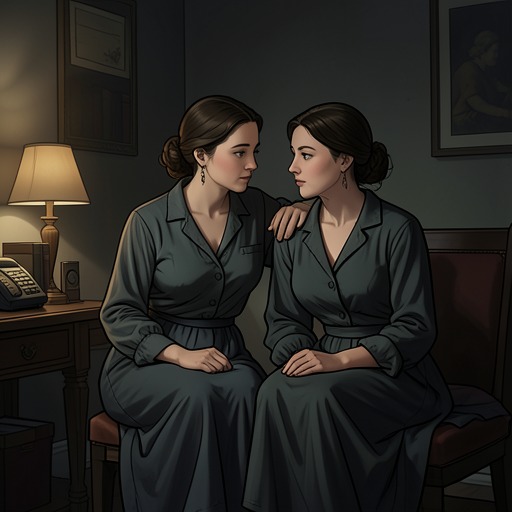
The Narrator and Friend’s First Kiss
What Are You Going ThroughThe Narrator and Friend’s First Kiss is the moment when an established tenderness between two women becomes unmistakably romantic. It begins not with a declaration but with an ordinary gesture: as the friend rests against the narrator while she reads, the friend lifts her head and kisses her. A joke follows, then a confession of unexpected feeling and guilt about parting. The scene makes intimacy both a comfort in the present and a sharper measure of what impending loss will leave behind.
Setting and Physical Closeness
By the time of the kiss, the two women have made a habit of sitting close. In the living room they settle side by side on the sofa, semi-reclined, legs stretched out and feet resting on the coffee table. The friend nestles against the narrator and sometimes lets her head fall onto the narrator’s shoulder. As the narrator reads, the friend more than once falls asleep. The narrator then stops reading and holds still, caught between feeling soothed by the sound of her friend’s breathing and being tormented by it.
That breathing draws the narrator back to the vigil beside her father in the hospital. His labored breaths had seemed like the output of a malfunctioning machine; when they stopped, the silence was more overwhelming than the sound had been. The kiss therefore occurs inside an intimacy already charged by bodily vulnerability and the possibility of death. The narrator’s stillness beside the sleeping friend is at once care and apprehension: she wants to preserve the comfort of their closeness, but cannot separate the sound of life from the memory of its sudden cessation.
Their closeness also belongs to a recurring ritual on the back porch. Sitting together on a two-seater to watch the sunset, they link arms or clasp hands. The friend sometimes squeezes the narrator’s hand without speaking, and the narrator experiences the gesture as an intimate communication that needs no explanation. She recognizes that the friend is a comfort to her as much as she is meant to be a comfort to the friend. The kiss grows out of this mutuality; it changes the meaning of their touch without making touch itself new.
The Kiss and Its Joke
The kiss comes while the narrator is turning a page. The friend lifts her head from the narrator’s shoulder and kisses her; the narrator laughs in surprise, then kisses her back. The sequence is brief but decisive: the friend initiates, the narrator responds, and a previously unspoken possibility becomes an action shared by both of them.
The friend immediately turns the opening into comedy, imitating Bette Davis as Baby Jane and asking, “You mean all this time we could’ve been lovers?” The joke acknowledges the history that precedes the kiss: they have already been physically close, attentive to one another, and accustomed to forms of touch that carry emotional weight. Its playful suggestion that they might have been lovers all along does not settle what their relationship should be called. Instead, humor lets the friend approach the recognition without converting it into a formal declaration. The laughter and returned kiss make the moment both startling and welcome.
The scene’s tenderness depends on its modest scale. There is no elaborate explanation before the kiss and no account of a planned change in their relationship. A page turns; a head lifts; a kiss is returned. The gesture supplies what the two have not yet said, while the joke opens a space in which they can acknowledge its significance without pretending that a label would resolve the circumstances surrounding them.
Unexpected Feelings and the Fear of Leaving
After the kiss, the friend says she has been selfish: she had not thought about the narrator, or allowed herself to do so. Now, with everything happening, she feels guilty. The narrator answers, “But I want to be here,” and recognizes as she says it that the statement is absolutely true. She feels that nothing could tear her away.
The friend clarifies that her guilt is not about the narrator choosing to be present. She feels guilty about leaving her behind. That distinction gives the exchange its force. The friend’s concern is directed toward the person who will survive her; the narrator’s answer is not a promise that the separation can be avoided, but a clear expression of her wish to remain beside her for as long as possible.
The friend admits that she had not counted on having feelings for the narrator or worrying about her. The narrator, in turn, had not counted on the feelings she was having for her friend. Their shared surprise prevents the kiss from reading as the fulfillment of a long-declared romance. It is instead a recognition that emerges within an extreme situation, when attention, worry, physical presence, and the prospect of loss have made a bond newly visible to both women.
The narrator considers how people caught in crises can become intensely close, even when they were strangers before. She recalls stories of disaster survivors who arrange reunions and of two people who met in an elevator trapped between floors, agreed to marry before they were rescued, and later broke their engagement while remaining friends. The anecdote offers a comparison, not a guarantee: closeness under pressure can endure, change, or fail to become a lasting partnership. The kiss itself does not answer what will follow. Its certainty is more immediate—the feelings are present, and neither woman had anticipated them.
Meaning and Retelling
The porch scenes frame the kiss with the beauty of sunset. As the changing sky holds both women still and dreamy, the narrator comes close to believing that everything is as it should be. That consolation is real but temporary. The friend’s admission that she feels guilty about leaving gives the romantic recognition its painful limit: the intimacy that makes the present feel right also makes the anticipated absence harder to imagine.
Later, the narrator explains that she began a journal intended to record her friend’s last days, then stopped almost immediately and discarded the few pages she had written. Writing felt like a betrayal not of her friend’s privacy but of the experience itself; words seemed unable to express what was happening without placing the record beside the reality it sought to preserve. That later struggle sharpens the significance of the kiss as an event remembered through gestures and consequences rather than fully explained. The page turning, the lifted head, the exchanged kiss, and the hand squeezed without words carry an intimacy that the narrator distrusts language to capture.
The first kiss does not erase the conditions of impending loss or resolve the women’s future. It reveals that the care passing between them is reciprocal and that both have developed feelings they did not expect. In the narrator’s account, the moment is therefore at once an arrival and a limit: a new form of intimacy becomes possible just as the friend’s fear of leaving makes their remaining time newly urgent.